
Blog Summary: Water heaters rarely fail without warning. Rust-colored hot water, strange noises, rising energy bills, and a unit past 8–12 years old are all signs worth paying attention to before the tank fails. This guide walks through a full checklist of warning signs, shows you how to check your unit's actual age from the serial number, and breaks down when repair still makes sense versus when replacement is the smarter call.
There’s never a good time for water heater problems. But there’s a special kind of bad timing reserved for the cabin: You drive up for the weekend, turn on the shower, and get 30 seconds of warm water before it turns to ice. Or worse, you come back after a few weeks away to find the utility closet flooded and the subfloor soaked through.
Most water heaters don’t fail without warning, though. There are often clear signs your water heater is going out, like a slight rumble, a rusty tinge to your water, and a slow climb in your energy bill. You should know which signals mean “don’t worry about it” and which mean “start shopping ASAP.” This checklist will help you tell the difference, plus show you how to find out how old your unit really is, since that number can separate a repair from a replacement.
How Old Is Your Water Heater?
Most homeowners have no idea how old their water heater truly is. If yours came with the house or cabin, you may only have a general ballpark figure. The good news is, you don’t have to guess. Every water heater has a serial number on its data plate (on the side of the tank for standard units or on the unit housing for tankless heaters). With that serial number, you can find the manufacture date.
How to tell how old a water heater is:
- Find the manufacturer’s label. It’s usually a sticker near the top of a tank unit, or on the front panel of a tankless unit.
- Locate the serial number, not the model number. They’re usually near each other, but while the model number tells you what unit you have, the serial number tells you when it was made. The serial number is usually the larger number on the label.
- Decode the first few characters. Most brands encode the month/year in the first few characters. Here are some common patterns:
- Letter-plus-numbers: The first letter represents the month (A = January, B = February, and so on) followed by two digits for the year. For example, a serial starting with “F24” would mean June 2024.
- All-numeric codes: Some brands lead with a two- or four-digit year (like “24” or “2024”) at the start of the serial number.
- Date-stamped separately: Some manufacturers print the manufacture date right on the label instead of encoding it in the serial number.
- Because the exact format depends on the brand, the safest move if you’re not sure what you’re looking at is to plug your model and serial number into the manufacturer’s website or snap a picture and send it to your plumber.
- Compare the install date to the expected lifespan below.
Expected lifespan by type:
Type | Expected Lifespan |
Standard tank | 8 - 12 years |
Tankless | 15 - 20 years |
Heat pump | 10 - 15 years |
If your unit is past its expected range, it’s time to start planning for a replacement, even if it’s still working.
10 Signs Your Water Heater Is Failing
Not every symptom means you need an immediate replacement. If you check off three or more, though, especially if your unit is already up there in age, it’s worth having a professional take a look.
Sign | Affects Tank Units | Affects Tankless Units |
1 | Past its expected lifespan | |
2 | Inconsistent or lukewarm water | |
3 | Rust-colored hot water | |
4 | Strange noises | |
5 | Water pooling around the base | |
6 | Rising energy bills with the same energy usage | |
7 | Pilot light or reset button won’t hold | |
8 | Error codes or frequent short-cycling | |
9 | Reduced flow or water pressure | |
10 | Rust visible at the tank or valve itself |
- It’s past its expected lifespan. See the age check above. If your unit is past its expected range, it’s on borrowed time.
- Your hot water is inconsistent or lukewarm. This usually means a failing heating element, if you have a tank heater, or a struggling heat exchanger if your unit is tankless.
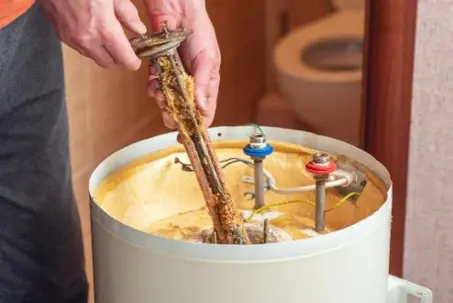
- Your hot water (and only the hot water) is running rusty. If it’s only the hot water, the rust is likely coming from inside your tank, not your water source or pipes.
- You’re hearing popping, rumbling, or banging. Sediment builds up and hardens at the bottom of the tank over the years of use. Once it’s hardened, it makes your water quality worse, and your unit works harder and wears out faster.
- There’s water pooling around the base of the tank. This sign can turn into real damage fast, especially at the cabin where nobody’s checking up on it daily. A slow leak that goes unnoticed can lead to a soaked subfloor or a ruined finished basement by the time you find it.
- Your energy bill is climbing, but your usage hasn’t changed. An aging unit loses efficiency gradually. If your bill has changed but nothing else about your household has, it might be your water heater.
- The pilot light won’t stay lit or keeps tripping. Resets happen sometimes, but frequent ones tell you a component is failing.
- Your tankless unit is throwing error codes or short-cycling. Tankless units are built to last longer than tank units, but when they start regularly throwing codes or cycling on and off without settling into steady operation, it’s a sign the internal components are wearing out.
- Water pressure or flow has dropped, especially on a tankless unit. Mineral scale can build up inside a tankless heat exchanger over time, especially if you’re dealing with Brainerd’s hard water.
- You can see rust or corrosion on the tank itself, the valve, or the fittings. Rust on the equipment is different from rust in your water. Once corrosion reaches the tank or valve, it’s almost always safer to replace it.
Tank vs. Tankless: Do the Warning Signs Differ?
Tank and tankless water heaters share some signs, but they also have a few key differences. Tank water heaters tend to show their age through sediment: noise, rust-colored water, and reduced efficiency as buildup collects at the bottom of the tank. Tankless units are more vulnerable to mineral scale coating the heat exchanger, which shows up as reduced flow, error codes, or the unit struggling to keep up with demand.
One upside for tankless owners is that annual descaling (flushing the system with a descaling solution) can meaningfully extend the unit's lifespan, especially in areas with hard water like Brainerd.
Should You Repair It or Replace It?
Here’s a rule of thumb that goes beyond “how old is it”: If a repair would cost more than half of what a full replacement runs, replacement is almost always the better financial call. You’re not just paying to fix today’s problem; you’re paying to delay a purchase you’ll likely make within a year or two anyway. If you’re not sure how much a repair or installation costs, get a quick inspection and estimate from a licensed plumber.
What Happens If You Wait Too Long?
A water heater tends to fail at the worst possible moment: mid-shower, mid-guest visit, or two weeks into a stretch when nobody’s at the cabin to notice. A slow, unnoticed leak escalates the issue from cold water to a ruined subfloor, warped carpentry, or a serious mold problem.
Catching the signs of water heater issues early, before the tank actually fails, is the difference between scheduling a replacement on your own timeline and dealing with an emergency call, water damage, or scrambling to find an emergency plumber on short notice.
Next Steps: Get Your Water Heater Inspected Before It Fails
If you’re checking off a few signs from the list above, don’t wait for the tank to make the decision for you. Schroeder’s technicians can inspect your unit, tell you honestly whether repair or replacement makes more sense, and walk you through financing options if a new install is the right call.
If your water heater has already failed, give us a call. We offer 24/7 emergency service for exactly this reason. Schedule an inspection or call 218-828-8127 to get started.
Want to stay ahead of water heater problems like this before they start? Many of our maintenance membership plans include scheduled inspections that catch sediment buildup, corrosion, and aging components before they become a Saturday-morning emergency.